Monday, July 9, 2012


Wednesday July 4.

It's the Fourth of July! A holiday of course at home, and my classmates and I decide to start our day with an “American” breakfast at When in Rome! Complete with American flags, and MTV it's a surreal mixture of Roman culture catering to American tastes. We had a hearty breakfast and started our day.
Today we will visit four churches; St. Maria, St Cecilia, Passede, and St Maria Maggorie. Due to blog size, I will write about St Maria of Trastevere and St Cecilia. 


Our first stop is St Maria in Trastevere. St. Maria is surrounded by the Piazza Santa Maria, our meeting spot each morning. The fountain is a symbol for the belief that this church is located where a spontaneous fountain of oil began with the birth of Christ, The church has undergone several restorations and therefore has artifacts and artwork from many time periods. The basilica was completely rebuilt in the 12th century, but dates back to the 3rd century. The mosaic on the front depicts Madonna and child surrounded by female figures dressed in royal clothing. As you walk into the church the exterior walls are covered in pieces of early medieval tombs, showing both Greek and Latin, along with symbols and Christian messages. Again we see a basic Basilica design. The massive columns are relics from other buildings in Rome. The flat ceiling is carved in high relief and painted in deep blues and gold. The mosaics in the triumphal arch and dome include Byzantine images of Christ and Madonna sharing the throne, as emperor and empress and scenes from the life of Mary by Cavallini. The frescoes are from the late 16th century showing scenes such as the annunciation and other bible stories begin to take on a more naturalistic style, rather than the flat emotionless art of the earlier mosaics. The images were made to help the poor people understand the stories, even if they could not read.


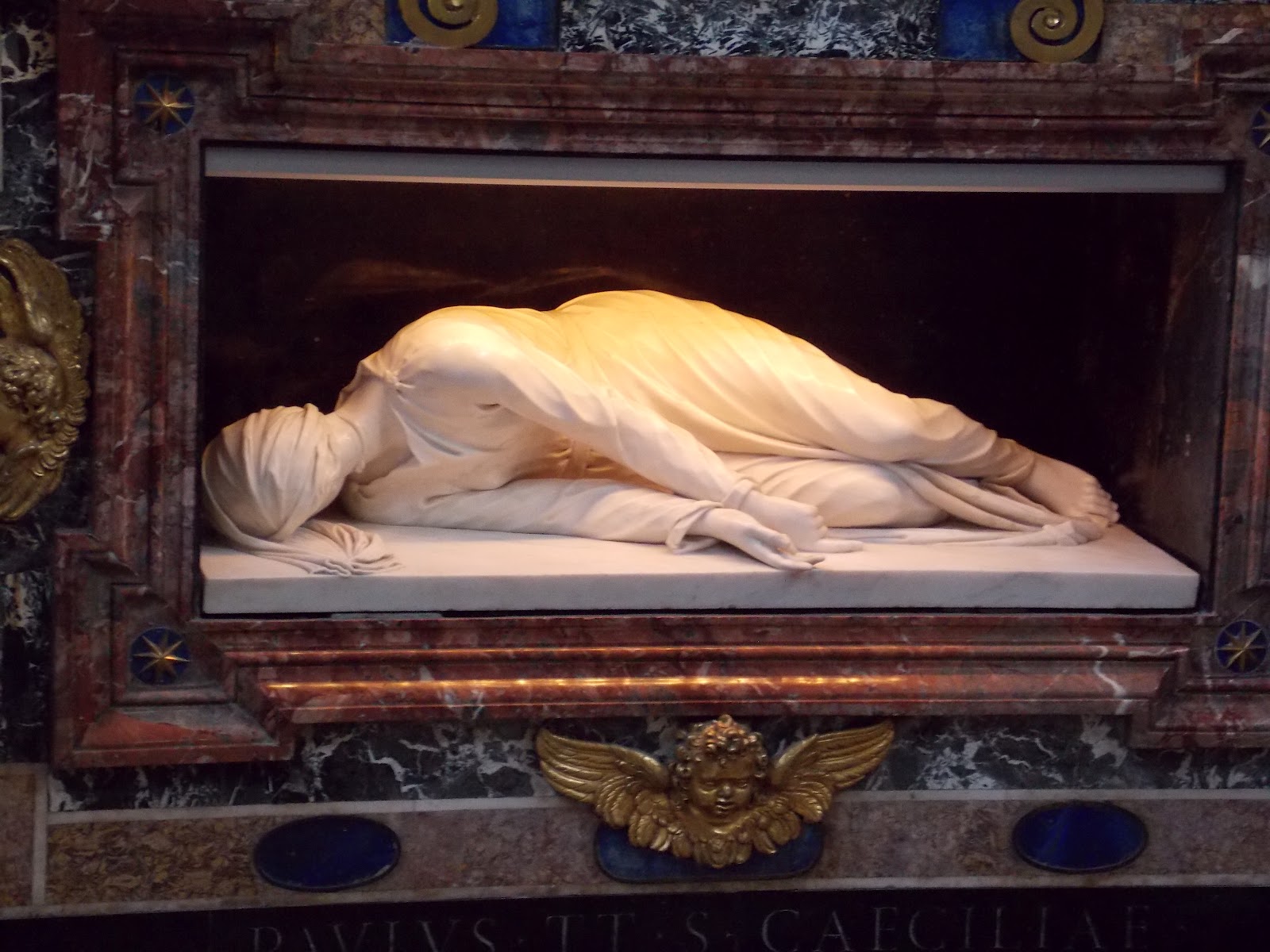
Our next stop is St Cecilia. Originally home to the 2nd century Roman noblewoman Cecilia, a patron of music who converted to Christianity and had a church within her home. The history of Cecilia shows that when she refused to stop practicing her religion the Roman empire tried to kill her. The attempts at scalding her to death were unsuccessful, so she was beheaded. Even in that attempt however, she remained alive for several days. It is said that she sang while dying. When the church was built in the 5th century her body was found, completely intact in her dying pose. She was removed from the site, but returned in the 9th century. Her tomb was reopened in 1599 and her body was still intact. It was at that time that the sculptor Maderno saw the body and created the sculpture that is placed above her tomb. The sculpture, while beautiful in its design and masterfully carved, is quite disturbing when you realize that the head is rotated 180 degrees due to the execution. 


This church has mosaics by Cavallini showing Christ and Mary enthroned, surrounded by popes and saints. There are frescoes by Cavallini as well, one of which is at ground level and can be seen up close. In this fresco depicting the last judgment, we begin to see a modeling of the flesh tones, and a movement toward realism.


Tuesday July 3.

The Pantheon
Our first stop of today is the Pantheon. The Pantheon, dedicated to all the gods (pan theon), was built on the site of a pagan temple that had been destroyed by fire in 110. The new temple, Pantheon was dedicated by Hadrian in 126. Public pagan worship was forbidden by a law passed in 346 and for years the Pantheon was abandoned and feared by Christians. In 609 it became the first temple to become a Christian Church. Today it stands out as one of the most complete of the ancient buildings of the Roman Empire. As you walk up to the portico of the Pantheon you realize the scale on a personal level. The 16 monolithic columns dwarf humans with a height of nearly 40'. This is impressive enough, until you learn that the columns were constructed in Egypt and shipped by a series of barges across the Mediterranean and then down the Tiber to Roma. The interior known to many of us in pictures, can not be described nor its beauty realized, until you have stood in it's space.  The dome weighs 4,999 tons and is the largest masonry vault ever build. The weight of the dome is counteracted by a gradual decrease in thickness from bottom to top, as well as a series of coffering in rings around the dome, 20 in each ring. The oculus provides the only light source to the building and acts as a compression ring in it's design. Originally it exterior of the dome was covered in bronze, although that was stripped by the Byzantium Emperor Constans II in 667. While visiting Rome in the early 1500's he claimed the design of the Pantheon to be, “angelic and not human design.” More than 1800 years after it was built, I would have to agree. 


At this point in the blog I must add a personal note, on today's visit to the Pantheon, the piazza was filled with people, both local and tourists. The was a duo of buskers playing guitar and violin. Their choice of music took me by surprise.... Hotel California, and Another Brick In The Wall!

Our next stop was to visit with one of the “Talking” Sculptures of Rome. The Pasquino, located in the Piazza Pasquino, is a Hellenistic style sculpture dating to the 17th century, named after a tailor that used it as a place to provide political commentary, by attaching comments on the base. This became a public source of narrative known as “pasquinade”. Through a series of statues placed throughout the city people were able to criticize the city leaders as well as the papacy in an anonymous way, in effect the statues themselves were carrying on these “conversations”. 
Pasquino 


Our third stop of the day was to the Capitoline Museum. As you enter into the lower courtyard, you are surrounded by pieces of what was the Colossal of Constantine. The 30' marble and bronze sculpture was built around 315 as a testament to Constantine's greatness. Statues were treated as Constantine himself and thus were required to be treated with respect. The Colossal was pillaged in late antiquity apparently to capture the bronze sections of the statue. The remaining marble body parts are now housed in the courtyard of the museum. Other highlights of the museum for me were the Hellenistic bronze statue “Boy With Thorn,” “Artemis Efesia” fertility goddess sculpture from the 2nd century, “Medusa” by Bernini from the 17th century, and the original “Equestrian statue of Marcus Aurelius” erected in 175 which is now located within the museum. The copy that stands in the Palazzo dei Conservatori was built in 1981.


 Not to leave two dimensional artwork out, “ The Fortune Teller” dated 1594, and “John The Baptist – youth with ram” dates 1604 by Caravaggio were my personal favorites. Pictures were not allowed in this museum, so family and friends will need to look up these artworks to learn more!


Thursday, July 5, 2012

Monday July 2, 2012


Our journey began today at 10:00 am at the Piazza St. Maria in Trastevere. This plaza is near our apartment and will be the meeting place for much of our time here in Rome. Roman history as seen through it's art is not easy to follow in a chronological order. Not only can centuries of history be found within one site, but each sites history is subject to redefinition through restorations and archaeological discoveries. You can not go from site A through to site Z and say; this is Roman history. But that is what we will attempt to do.
Our first two stops today were the Medieval churches of Santi Quattro Coronati and San Clemente. The San Clemente Basilica stands as a perfect example of the richness of complexities that can be found within one site. There is a 12th century church built above a 4th century church that is built upon a 1st century republican period private home which includes a early 3rd century Mithraic temple. Each of these levels had responses to the earlier periods in the artwork that was created, and in the reuse of materials from the earlier buildings. The upper Church is built in the traditional Basilica conventions with a flat ceiling, a nave with an apse on one end, and two isles separated by columns. The lower church is a series of catacombs that still have remnants of fluted columns and frescoes dating to the 5th century. This church was founded in Rome at a time when religion was not personal but rather ritualistic in nature.

The artwork found within the Basilica is as varied as the history of the building itself. The upper church includes frescoes by Masolino and Masaccio from the 13th century as well as 18th century restorations to the ceiling, and frescoes by Chiari. The lower church has remnants of 11th century frescoes as well as 5th century Byzantine frescoes. In the earliest sections of the church there is an alter in the temple that depicts the symbols of the Persian cult Mithras from the 3rd century. The imagery found in this church will lay the groundwork for understanding what we will see over the next few days. We will see repeating patterns and symbols that will allow us to better understand the reasons behind the art. (No photos were allowed within this Basilica.)

Our afternoon included a trip to the area of Rome that is home to the rich history of The Forum, The Coliseum, and The Arch of Constantine. The Forum began in the 1st century as a marketplace in the time of King Servius Tullius. Located in the heart of the city, it became a mix of both sacred and secular buildings and iconography. Under Imperial rule the Forum grew as each new emperor had a new arch or column erected to show their victories and thus gain the favors of the Gods. These images began to make their way into the churches, and Imperial iconography was used to influence the people. As Christianity began to take over as the common religion, the temples were made into churches, or churches were built over the temple sites. Many of the original arches and columns can still be seem today, and excavation is still in progress at the site.
The Arch of Septimius Severus
The Coliseum
 The Coliseum, which is located just to the East of the Forum was the first amphitheater to be built in stone, and was the largest ever built by the Romans, holding more that 55,000 people. The Emperors used the Coliseum to hold spectacles and events to win the favor of the people. The most common of these events were fights to the death between gladiators, or between animals and men. This was also the location of many executions, and is now dedicated to Christian martyrs. The Coliseum highlights one of the basic principles of Roman architect, a repeating pattern of arches . Although the Coliseum did receive damage through earthquakes on several occasions, many of the stones that are missing from the exterior today were actually used for other buildings in Rome.
 The Arch of Constantine was dedicated in 315AD to honor Constantine's victory over his co-Emperor Maxentius, The arch includes elements of previous arches, seemingly attempting to link himself to the past in Romans eyes. These building represent the beginnings of Roman history, which is as complex as the buildings themselves. 

More tomorrow!

Wednesday, July 4, 2012

My first day in Rome - Sunday July 1


My first morning to wake in Rome! Only 3 hours of sleep, but my body seems confused... but the swallows are so noisy outside of my room that I find it impossible to stay asleep any longer. I have a Caffe Americano waiting for me, I must find it! The streets are very quiet....where is everyone? Oh, wait...there is the church bell...its 6 am on Sunday morning! I will explore until the bars open.... (coffee bars)

I did it! I walked into the bar, ordered a caffe Americano... oops, I forgot, we pay first. I am lucky, it is Sunday and not busy and the lovely lady behind the bar excuses my error. I have a wonderful coffee and cream croissant and take in the beautiful morning conversations. I will relax now, because the day has much in store for me. I meet with the class today, go to the apartment that will be home in Rome, and later today we will have what our schedule shows as a brief walk about the city as a way of introduction, and dinner as a group. My official school blogs will begin tomorrow. In these blogs I will be able to share events of the day, the history and the art that I am seeing. I will throw in as much of my personal day as room allows, but remember, I am not here for vacation! :)

Saturday, June 30, 2012


The Trip!

A.M. Portland time Friday June 29.
All the planning and packing, list making and dreaming are done! The time to travel is NOW! The flight will take me first to Amsterdam, with a quick turnaround to the connecting flight to Rome. Approximately 11 hours in the air for my first International flight! Nervous? YOU BET!
But the excitement is almost more than my body can hold in! It's time to board! Here I go!

A.M. Roman time Saturday June 30.

I am on Roman soil! Before I go any further, I must say that the most difficult part for my brain to adjust to is that I left American soil in the AM, and arrived here in the AM the following day, without traveling through any darkness other than the airline imposed drawing of the shades for the sake of those watching movies. I will have to ponder that for a bit...

The flights themselves were quite nice with nothing notable to write about. As we descended for the landing in Amsterdam we opened the shade to get our first glimpse of a new land. (actually, the man in the seat nearest the window had traveled here many times, but he was a nice chap and opened the shade for me) The cloud cover was such that at first I was unable to see land, and then... The pilot shut down the engines! OK so maybe he just changed the acceleration but suddenly it seemed as if we were silently gliding through the clouds. When we broke through the cloud cover my first sight was a waterway filled with red vessels that reminded me of sprinkles on a Christmas cookie. The water was also home to what at first looked like white crosses, and in my artists way I immediately thought it was a political statement art installation! But no, as we descended I could see it was windmills...my first impressions, Christmas cookies and crosses, maybe I should have slept on the plane?

The serenity of the landing was soon shattered by the reality of gate locations for my connecting flight. But I made it, just as the plane was boarding, and this time I had a window seat! I was hoping luck would be on my side to see the countryside of Italy as we flew over. Maybe I would even get a glimpse of the Carrara marble quarries....As we took off, it seemed as if we were flying over Iowa farmland. Flat sections of land in various stages of growth or fallow. Pretty, but not what I expected. I am in a new land, shouldn't it look different? Then the clouds set in... disappointed, I turned my attention to yet another snack delivery.

My next glance out the window had heads turning to make sure I didn't need attention. My reaction was intense, and verbal. OMG.....I was looking right at the Alps....It will take me days to find the words to describe the beauty. Now THIS is what I was waiting for! My eyes never left the window, and I was NOT disappointed! The land quickly changed in appearance after we passed the mountain ranges. The only way I can describe it was that the land looked like a swirling patchwork quilt, or maybe a moment in time captured by a kaleidescope... even the land here is art! My imagination flew with thoughts of living here and tending a vineyard...

Again, serenity ceased by airport reality! After finding my luggage on a conveyor meant for another airline, I was off to find a taxi.... what was I thinking!? After dropping me off blocks away from my destination and collecting his 60 euros, he was off. Now that I am safely in my room and able to look at the MPH/KM conversion I realize that I was driven to Rome at a pace of about 95 to 100 miles per hour....wait, I thought Europeans liked to take it slow... back to my story. The view was pretty dirty as we left the airport and I wondered if my lifelong dreams would be shattered by current conditions of a big city. And then we passed through the Aurelian walls, and I gawked like a kid at a candy store! Oh yeah...this is it! I shall save my insights for Rome itself for the blogs to follow in the days ahead. I am in Roma....the cobbled, scooter lined streets are awaiting my exploration.... Arrivederchi!

Thursday, June 14, 2012

Preparations...

I am gathering luggage and making endless lists! 15 days until I board the plane for the adventure of a lifetime! Not to mention a learning experience that I will carry into my classroom when I begin to teach! Ah yes, life is amazing! Watch out Rome... A River is about to run through....

Wednesday, June 6, 2012

Waiting Wylde!

I am busy in preparation for my trip! It is unbelievable how fast the time is slipping by.  In 23 days I will begin my adventure to study art in Rome for two weeks! This blog will serve as my daily log for pictures and stories of my days while there! I hope you will enjoy the adventure with me!